SpaceGoats / Case study
I led a team to build a game about an escaping goat colony.
I made SpaceGoats for a national Italian game-design competition. I led the team, served as lead programmer, and combined a one-button platformer with a colony-management system about sustainability.
What I had to solve
I needed to make sustainability playable.
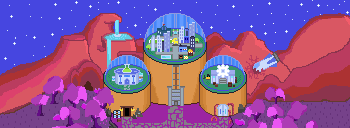
I started from UN Sustainable Development Goal 11. My team and I paired a fast platforming loop with a slower colony loop: I send the goat into mines for food and metal, repair geothermal equipment, and spend resources on upgrades that make the colony more independent.
How my loop works
I connected short runs to long-term upgrades.
- I choose the mine, energy facility, or greenhouse from the colony.
- I run automatically and use one button for jumps and wall jumps.
- I watch oxygen and health while collecting food and materials.
- I only keep the resources if I return safely.
- I spend them on the goat and the colony.
- I finish upgrade stacks to make the colony self-sufficient.
How I handled character upgrades
I store oxygen, health, maximum speed, and jump force in a shared GoatStats ScriptableObject. I made the speed and jump sliders use the player’s unlocked maximum, so upgrades create more choice instead of forcing the hardest setting.
How I handled colony upgrades
I made each upgrade a data asset with its text, resource costs, and UnityEvents. My UpgradeManager builds the progression stacks, loads saved levels, updates the interface, and checks when the required stacks are complete.
How I structured it
I connected small systems with events.
I built the project in Unity 6 with C#, URP 2D, the Input System, Tilemaps, TextMesh Pro, post-processing, and LeanTween. I shipped six scenes: the story, colony, energy facility, two caves, and greenhouse.
How I made one-button movement work
I BoxCast in four directions and classify each physics frame as ground, air, wall, or corner. I keep a short contact history so the goat preserves its direction through transitions. I also added grace frames, input buffering, variable jump time, wall sliding, and acceleration limits so one button still feels responsive.
How I handled a run
I use a persistent GameManager with events for startup, scene loading, run start, victory, game over, reset, and returning to the colony. I connect health, oxygen, resources, UI, and transitions to those events instead of letting every component control the whole run.
How I saved the world
I identify each resource by its type, scene, and position. I save its remaining regrowth or repair time as JSON in PlayerPrefs. I also save food, materials, upgrade levels, and player progress between scenes and sessions.
How I shipped it
I packaged the same Unity project as a WebGL/PWA build and an Android APK.
How I led the team
I had to manage the project, not just my code.
I coordinated the team in Italian, set internal deadlines, split up feature work, and kept everything moving toward one complete build. I used feature branches for UI, art, resources, upgrades, and levels, then integrated them into main. That let us work in parallel, but I also dealt with reverts, rebases, scene conflicts, and late fixes near the deadline.
What I completed with the team
- I worked from the first repository setup in December 2024 through the final fixes in April 2025.
- I integrated movement, regrowth, oxygen, resources, upgrades, minimap UI, audio, story scenes, and accessibility sliders.
- I merged separate contributor branches into one shared game instead of collecting disconnected demos.
- I produced the final WebGL and Android builds from the integrated project.
What I learned
I learned as much from integrating the game as I did from programming it.
- I make difficult controls forgiving internally. My one-button interface still needed contact states, grace frames, buffering, variable jump force, and careful wall behavior.
- I separate data from behavior. ScriptableObjects let me tune statistics, resources, and upgrades without hard-coding everything into scenes.
- I design saving early. My scene-and-position IDs work, but I would use stable IDs if I rebuilt the levels.
- I document event ownership. UnityEvents reduced coupling, but I would make their order and save responsibilities clearer next time.
- I integrate branches more often. Scene conflicts taught me to use smaller commits, clearer ownership, and regular merges.
- I treat accessibility as part of the mechanic. One-button input and adjustable movement became part of the game’s identity.